

The Man
On the morning of December 1st, 1948, just southwest of Adelaide, South Australia, on Somerton Beach, John Bain Lyons and his wife noticed what seemed to be a corpse of a man with his head lying against the seawall, legs stretched out with his feet crossed. He extended his right arm up, and then let it fall down. He looked both drunk and asleep to the couple. The police were soon contacted, and the man was brought to the Royal Adelaide Hospital.

At the hospital, an autopsy was conducted. Dr. John Barkley Bennet estimated the time of death at around 2:00 am, with the cause of death being supposed to be heart failure, likely being caused by poisoning. The man wasn’t identified, still being a mystery to this day. Searching the contents of the man’s pockets, they found an unused train ticket from Adelaide to Henley Beach, a bus ticket, a US manufactured aluminum comb, a half-eaten pack of chewing gum, a packet of Army Club cigarettes containing only 7 cigarettes that belonged to a different brand, and a quarter-full box of matches. The man carried no ID, and all of the labels on his clothes had been removed. Detectives noted that he had one pocket in his pants that had been repaired with an orange thread.
The Suitcase
A few days prior to the discovery of the body, November 30th, a brown suitcase with a removed label was checked into the Adelaide railway system cloakroom. Staff discovered it a while later, on January 14, 1949. It contained the very same orange thread that was used to repair the pocket in the body’s pants. In the suitcase, the names “Keane” or “Kean” appeared regularly throughout the search. The name “T. Keane” was found on a tie, “Keane” on a laundry bag, and “Kean” on an undershirt.
The rest of the contents contained a stencil kit, a table knife with a cut down haft, a dressing gown, a red felt pair of slippers, four pairs of undergarments, Pyjamas, shaving items, a light brown pair of pants, an electricians screwdriver, a pair of scissors, and a small square of zinc.
The Final Piece
Coroner Thomas Erskine Cleland, Emeritus Professor of Pathology at the University of Adelaide, conducted an inquest of the body a few days after its initial discovery at the beach. However, this was adjourned until June 17th, 1949. Cleland re-examined the body and all of its belongings. During this, he made a discovery which every examiner had missed. He found a tightly rolled piece of paper stored inside of a small pocket that was sewn into the pants of the corpse. The paper, when opened, contained the printed words “Tamám Shud”.
Public libraries had translated the Persian phrase into the words “finished” or “it has ended”. They had also recognized the words to belong to a book titled “Rubaiyat of Omar Khayyam”. A full Australia wide search for the copy of the same book had soon been conducted, but provided no results for some time.
A burial for the man had been arranged, but police had embalmed the man beforehand, creating a cast of the head and upper torso. His body then was buried under a plot of dry ground, sealed by concrete. After the burial, flowers started appearing around the grave at strange intervals. The person or people that left the flowers are still unidentified.
Eight months after the search for the copy of the Rubaiyat, a Glenelg man, with the alias of “Ronald Francis”, showed the police a 1941 version of the translated Rubaiyat. This book had the same phrase ,“Tamám Shud”, from the torn paper found on the body. The man didn’t know that this book was connected to the corpse until the day before when he saw a search for it in the newspaper.
On the back of this returned book lies five lines of faint letters, resembling a code. The second line had been crossed out, hinting at an encryption error. The first 3 lines had been separated from the last 2 by an X with 2 strikes through it. The message is listed below:
WRGOABABD
MLIAOI
WTBIMPANETP
X
MLIABOAIAQC
ITTMTSAMSTGAB
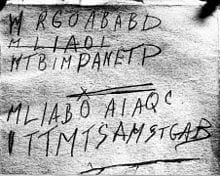
Decoders were unsuccessful in cracking the code. The message was sent to Naval Intelligence, but was again unsuccessful. The code was then published to the public, leaving amateur decoders stumped. The Navy soon decided that the code was uncrackable.
This is the final piece of evidence that police and investigators ever recorded since the 1950s. The mystery was put at rest, leaving it unsolved. Many people have decided to pick the case back up in recent years, but have been unsuccessful. The case still remains a mystery, with the man never being identified, and with the killer still on the loose.