The Voynich Manuscript – a 600 Year Old Mystery

The Voynich Manuscript – a 600 Year Old Mystery

The Voynich Manuscript is a handwritten book, carbon-dated to the early 15th century (around the 1400s). It’s written in an unknown language that many call “Voynichese”. Many of the pages contain simple drawings of a variety of subjects. The entire codex currently has a total of 240 pages, however there are some that appear to be missing. Using the page numbering written inside of the book, and investigating the gaps between pages, it’s suspected that the whole manuscript once had around 272 pages in total.

A picture of the manuscript with writing and illustrations.

A Brief Description

The manuscript doesn’t have an official name, only commonly referred to as “The Voynich Manuscript” after a man named “Wilfrid Voynich”. Voynich purchased the book some time in 1912. Later, in 1969, the manuscript made its way in Yale University’s Beinecke Rare Book and Manuscript Library. A few years ago, back in 2020, Yale University published the entire  manuscript online for their digital library.

After many years of investigation and study, the language remains undeciphered. Many professionals and codebreakers attempted to decipher it during both world wars, but were unsuccessful.

The Investigation

As stated before, the pages had been carbon-dated to the early 1400s, sometime around 1404 to 1438. The manuscript had also been protein tested, showing results that the pages were made of calfskin, composed of at least 14 entire calf skins. Goat skin composes the binding and covers.

Polarized light microscopy had revealed that the ink the manuscript had used consisted of iron gall ink written with a quill pen. The ink was used for both the writing and the outlines of the drawings. Extra analysis provided evidence that the ink had traces of many different minerals, such as carbon, iron, sulfur, potassium, calcium, copper, and zinc.

Paint had covered the pages to color in the ink outlined drawings. All the colors have been analyzed. The blue paint was made of ground azurite with small amounts of copper oxide cuprite. The white paint consisted of calcium carbonate and egg-white. The green paint had copper-chlorine and atacamite. Finally, the red paint was made of red ochre, with traces of hematite and iron sulfide.

The text had many unknown characters, with some only showing once or twice. It reads from left to right, and there is no punctuation. Most of it is written in a single column with paragraph divisions and a jagged right margin. Over 170,000 characters are counted within the manuscript.

The illustrations and text both have characteristics of a European origin. For further evidence, the materials in the paint that was listed above consisted of minerals usually obtained from Europe in the suspected timeframe the book was written.

An illustration of a dragon from the manuscript

The History

Georg Baresch is one owner of the manuscript, being its first confirmed owner. Georg was a Prague alchemist from the 17th century. While the book was being stored in Georg’s library, a scholar named Athanasius Kircher had published an Egyptian dictionary. Georg sent a sample of the book to Athanasius, asking him to send him a translation. As the manuscript is not written in egyptian, the book was never translated. Athanasius acquired an interest in the manuscript because of this.

Athanasius asked Georg to send him the entire manuscript, but Georg refused. After Georg’s death, the book was given to his friend, Jan Marek Marci, who also happened to be friends with Athanasius. The manuscript was swiftly given to Athanasius.

The manuscript stumped Athanasius, so it was stored in the Collegio Romano library for two hundred years. The manuscript remained in this library until Victor Emmanuel II of Italy annexed the Papal States. Victor’s new government wanted to seize church properties, which included the library the manuscript was stored in. The book eventually made its way to a private library owned by the Society of Jesus.

Sometime in 1903, the Society ran low on money. The Vatican Library offered to purchase some books from them, which they succeeded in. 30 different books were shipped to the Vatican library. One of these books was the Voynich Manuscript itself. Wilfrid Voynich, the man listed before whom the manuscript was named after, acquired these books, and noticed the manuscript. He didn’t recognize the language, so for the next several years he urged scholars to attempt to decipher the manuscript.

A picture of Wilfrid Voynich

Shortly after Wilfrid’s death, the manuscript was passed down to his wife, Ethel Voynich. Later, when Ethel died, it was passed to her friend Anne Nill. Sometime after, Anne sold the book to Hans Kraus, an antique book dealer. Being unsuccessful in finding an interesting customer, Hans donated the manuscript to Yale University, where it sits to this day still unsolved.

The Body on Somerton Beach

The Body on Somerton Beach

The Man

On the morning of December 1st, 1948, just southwest of Adelaide, South Australia, on Somerton Beach, John Bain Lyons and his wife noticed what seemed to be a corpse of a man with his head lying against the seawall, legs stretched out with his feet crossed. He extended his right arm up, and then let it fall down. He looked both drunk and asleep to the couple. The police were soon contacted, and the man was brought to the Royal Adelaide Hospital.

At the hospital, an autopsy was conducted. Dr. John Barkley Bennet estimated the time of death at around 2:00 am, with the cause of death being supposed to be heart failure, likely being caused by poisoning. The man wasn’t identified, still being a mystery to this day. Searching the contents of the man’s pockets, they found an unused train ticket from Adelaide to Henley Beach, a bus ticket, a US manufactured aluminum comb, a half-eaten pack of chewing gum, a packet of Army Club cigarettes containing only 7 cigarettes that belonged to a different brand, and a quarter-full box of matches. The man carried no ID, and all of the labels on his clothes had been removed. Detectives noted that he had one pocket in his pants that had been repaired with an orange thread.

The Suitcase

A few days prior to the discovery of the body, November 30th, a brown suitcase with a removed label was checked into the Adelaide railway system cloakroom. Staff discovered it a while later, on January 14, 1949. It contained the very same orange thread that was used to repair the pocket in the body’s pants. In the suitcase, the names “Keane” or “Kean” appeared regularly throughout the search. The name “T. Keane” was found on a tie, “Keane” on a laundry bag, and “Kean” on an undershirt.

The rest of the contents contained a stencil kit, a table knife with a cut down haft, a dressing gown, a red felt pair of slippers, four pairs of undergarments, Pyjamas, shaving items, a light brown pair of pants, an electricians screwdriver, a pair of scissors, and a small square of zinc.

The Final Piece

Coroner Thomas Erskine Cleland, Emeritus Professor of Pathology at the University of Adelaide, conducted an inquest of the body a few days after its initial discovery at the beach. However, this was adjourned until June 17th, 1949. Cleland re-examined the body and all of its belongings. During this, he made a discovery which every examiner had missed. He found a tightly rolled piece of paper stored inside of a small pocket that was sewn into the pants of the corpse. The paper, when opened, contained the printed words “Tamám Shud”.

Public libraries had translated the Persian phrase into the words “finished” or “it has ended”. They had also recognized the words to belong to a book titled “Rubaiyat of Omar Khayyam”. A full Australia wide search for the copy of the same book had soon been conducted, but provided no results for some time.

A burial for the man had been arranged, but police had embalmed the man beforehand, creating a cast of the head and upper torso. His body then was buried under a plot of dry ground, sealed by concrete. After the burial, flowers started appearing around the grave at strange intervals. The person or people that left the flowers are still unidentified.

Eight months after the search for the copy of the Rubaiyat, a Glenelg man, with the alias of “Ronald Francis”, showed the police a 1941 version of the translated Rubaiyat. This book had the same phrase ,“Tamám Shud”, from the torn paper found on the body. The man didn’t know that this book was connected to the corpse until the day before when he saw a search for it in the newspaper.

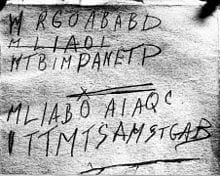
On the back of this returned book lies five lines of faint letters, resembling a code. The second line had been crossed out, hinting at an encryption error. The first 3 lines had been separated from the last 2 by an X with 2 strikes through it. The message is listed below:


WRGOABABD

MLIAOI

WTBIMPANETP

           X

MLIABOAIAQC

ITTMTSAMSTGAB

Decoders were unsuccessful in cracking the code. The message was sent to Naval Intelligence, but was again unsuccessful. The code was then published to the public, leaving amateur decoders stumped. The Navy soon decided that the code was uncrackable.

This is the final piece of evidence that police and investigators ever recorded since the 1950s. The mystery was put at rest, leaving it unsolved. Many people have decided to pick the case back up in recent years, but have been unsuccessful. The case still remains a mystery, with the man never being identified, and with the killer still on the loose.

A Man Named D.B. Cooper

A Man Named D.B. Cooper

On the afternoon of the 24th of November, 1971, a man carrying a black attaché case and referred to himself as “Dan Cooper” entered the Portland International Airport and bought a one-way ticket on Flight #305; Portland, Oregon to Seattle, Washington. Cooper was assigned seat 18C and ordered a drink before takeoff.

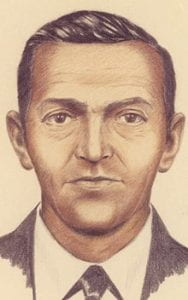
Cooper was a white male, wearing a white shirt with a dark business suit and tie. He appeared to be in his mid-40’s and was a quiet man with little accent. Boarding the plane he drew no attention to himself.

The plane, a Boeing 727 aircraft, carried 42 occupants in total. 36 passengers (including Cooper), Captain William A. Scott, First Officer William “Bill” J. Rataczak, Flight Engineer Harold E. Anderson, and three flight attendants, Alice Hancock, Tina Mucklow, and Florence Schaffner.

The Hijacking

The aircraft left Portland on schedule at 2:50 pm PST. Shortly after, around 3:00 pm, Cooper handed flight attendant Schaffner a note. At the time, men traveling alone would usually hand flight attendants notes with phone numbers or hotel room numbers written on them, so Schaffner assumed it was only a business man’s phone number. Schaffner ignored the note, quietly slipping it unopened into her purse. The next time she passed, Cooper whispered to her, “Miss, you’d better look at that note. I have a bomb.”

The note read in neat handwriting, “Miss – I have a bomb in my briefcase and want you to sit by me.” The shocked attendant did as she was told. She then asked to see the bomb. Cooper opened his cheap case and showed a glimpse of two rows of four red sticks, which was presumed to be dynamite, all connected to a mass of wires that led to a cylindrical battery. Soon, Schaffner was walking to the captain with a new note of Cooper’s demands: $200,000 in negotiable American currency, two front parachutes, and two back parachutes, all given to him by 5:00 pm.

After reading the note, Captain Scott immediately contacted air traffic control. They then contacted the Seattle Police who contacted the FBI. The FBI urgently called the airline’s president, Donald Nyrop, who then stated to comply with the demands given by Cooper. After this, Cooper instructed the flight attendant to return the note to him, removing incriminating evidence and leaving the exact wording unknown, but everyone present agreed that the note contained the words, “no funny business”.

With Schaffner in the cockpit, Cooper moved to the window seat so that flight attendant Mucklow could sit in the isle to act as a liaison between them and the cockpit. Cooper told Mucklow to tell the captain to stay in the air until the money and parachutes were ready. He also made additional demands; when landing in Seattle, all passengers would remain onboard until Cooper had the money, then he would let them go. The plane circled Puget Sound for about 2 hours to give the FBI enough time to obtain the needed resources. While the plane was circling, Mucklow asked why Cooper was hijacking this airlines specifically. Cooper replied, “It’s not because I have a grudge against your airlines, it’s just because I have a grudge,” he stopped and said that this airlines just fulfilled his needs.

The $200,000 was received in $20 bills, with random serial numbers which complied with Cooper’s request. Every bill had a serial number starting with “L”, however, specifically planned by the FBI. Tacoma’s McChord Air Force Base offered to supply the parachutes, but Cooper rejected this offer; he wanted regular civilian parachutes, not military grade ones. Seattle Police eventually contacted a local skydiving school, and bought the two front parachutes from them. The two back parachutes were obtained from a local stunt pilot.

In the Sky Again

At 5:46 PST, the plane arrived in the Seattle-Tacoma airport. Cooper told them that only one representative was allowed to bring the money and parachutes, and the only entrance/exit would be the plane’s front door. When this played out to Coopers demands, Mucklow traveled to the front entrance to receive the supplies from Al Lee, Northwest Orient’s Seattle operations manager. The 36 passengers were then released, with Cooper keeping several crew members (flight attendants Hancock and Schaffner being an exception, as they requested to debark from the plane), and the plane took off for a set course to Mexico City.

Sometime after takeoff, Cooper asked Mucklow to lower the back aircraft stairs. Mucklow expressed her fear many times of doing this, to which Cooper replied saying he would do it himself. He instructed Mucklow to go to the cockpit and close the curtain partition between Coach and First Class. He told her to not return.

By 8:13 pm, the warning light for the aft staircase lit. Pilot William Scott asked if he needed assistance, with Cooper replying his final message anyone ever heard from him again, “No.” The plane’s tail pitch upwards, and Cooper jumped out of the aircraft with the parachutes and money, never to be seen again.

Cooper’s fate still remains a mystery to this day.


Sources: Wikipedia, FBI.gov, Crimemuseum